
Written by
Lukas
•
•
SaaS

Between 30 and 50 percent of new customers drop out during onboarding. Not because the product is bad. Because the delivery process didn't scale with the sales pipeline.
That number isn't from a single vendor. It shows up across the entire SaaS industry – from Cloud Coach research to ProductLed analyses. And it hits hardest at companies that are actually growing. Sales is humming. Pipeline is full. Every week, another contract gets signed.
The customer just never gets started.
The Tipping Point: When Growth Becomes Gridlock
There's a phase in every growing IT services company where something shifts. At first, you barely notice. Sales brings in three new customers a month instead of two. The onboarding team handles it – with overtime, improvisation, weekend calls.
Then it's five. Then seven.
And suddenly this happens: the same people running onboarding are also handling support tickets from existing customers. They jump between project work and ad-hoc escalations. Resource plans change daily. Priorities hourly.

A B2B SaaS platform in Munich – HR software, about 35 employees – ran the numbers in 2023. Average onboarding time had doubled from 6 weeks to 14. In two years. Not because the software got more complex, but because the team stayed the same while sales accelerated.
Every new customer delayed the existing ones. A vicious cycle you only notice once it's already spinning. The tricky part: the early warning signs of project delays are often invisible because everyone looks busy.
The Expensive Illusion: "But the Customer Is Paying"
This line comes up in almost every conversation about long onboarding projects. And it sounds logical. Revenue is revenue.
Except the math doesn't work.
Yes, the customer pays. But what does that payment cost? Expensive specialists stuck in firefighting mode. Constant replanning. Coordination overhead that doesn't show up in any ticket. Operational stress that eventually shows up in sick days.
Bain & Company put it in numbers: acquiring a new customer costs 5 to 25 times more than keeping an existing one. When capacity gets burned on slow onboarding instead of efficient, repeatable processes, you lose at both ends. Existing customers wait too long. New ones can't even start.
Every additional minute of time-to-value drops conversion by 3 percent. Not 3 percentage points – 3 percent relative.
And then there's the number nobody likes to say out loud: only 12 percent of users rate their onboarding as "effective." Twelve. That's not a weakness of individual vendors. That's an industry-wide problem.
Where the Real Bottleneck Lives
You might think: just hire more people. But that's roughly as helpful as telling a traffic jam to build wider roads. It helps short-term. And moves the problem downstream.
The actual cause sits deeper.

Many growing SaaS companies have no clean separation between customer onboarding, ongoing support, and product development. The root causes mirror the reasons why IT projects fail in general – missing structure, unclear ownership, no system. The same people are expected to do everything at once. One week they're onboarding, the next they're debugging, and on Fridays they're in sprint planning.
Processes? Evolved organically, never designed. Documentation? In the head of the colleague who's currently on vacation. Capacity planning? Gut feeling.
What Emergency Rooms Get Right
Hospitals have triage. A system that decides in seconds: who gets treated first? The decision isn't based on who's loudest or who arrived first, but on clear criteria.
In many IT companies, that role falls to the CEO. Personally. Daily. With the result that both prioritization and everything else suffer.
Hospitals that switched to AI-assisted triage now automate a significant share of routine assessments – according to research published in the Journal of Medical Internet Research, up to two-thirds of initial evaluations. Not because doctors got worse – but because the system handles the sorting that used to drain energy.
A software company in Hamburg – on the market since 2019, building project management tools for agencies – knew this pattern well. In 2024, every new customer needed an average of eight weeks to their first login. Not because of technical barriers, but because every account manager had built their own setup. Own checklists. Own email templates. Own documentation. When someone was out, the next person started from scratch. Project knowledge evaporated. Customers waited. Churn climbed.
What Scaling Companies Do Differently
The companies that solved the onboarding problem didn't just hire more people. They changed the structure.
Four things stand out when you look at the ones that figured it out:
Roles are separated. Whoever onboards doesn't handle support. Sounds obvious. Rarely happens in practice.
Processes are standardized. Not in the sense of "we have a wiki nobody reads." In the sense that every onboarding follows the same structure, with the same work packages, the same checkpoints. New hires are productive on day one because the system guides them – not the predecessor.
Capacity is visible. Not in a spreadsheet that's current on Monday and outdated by Wednesday. In a planning view that shows: who has how much capacity this week? Where's the next bottleneck forming? When can the next customer start?
Customers see where they stand. Transparency kills status-update emails. When customers can check their onboarding progress themselves, the "Where are we?" messages disappear. That doesn't just save time – it builds trust.
What This Looks Like in Practice
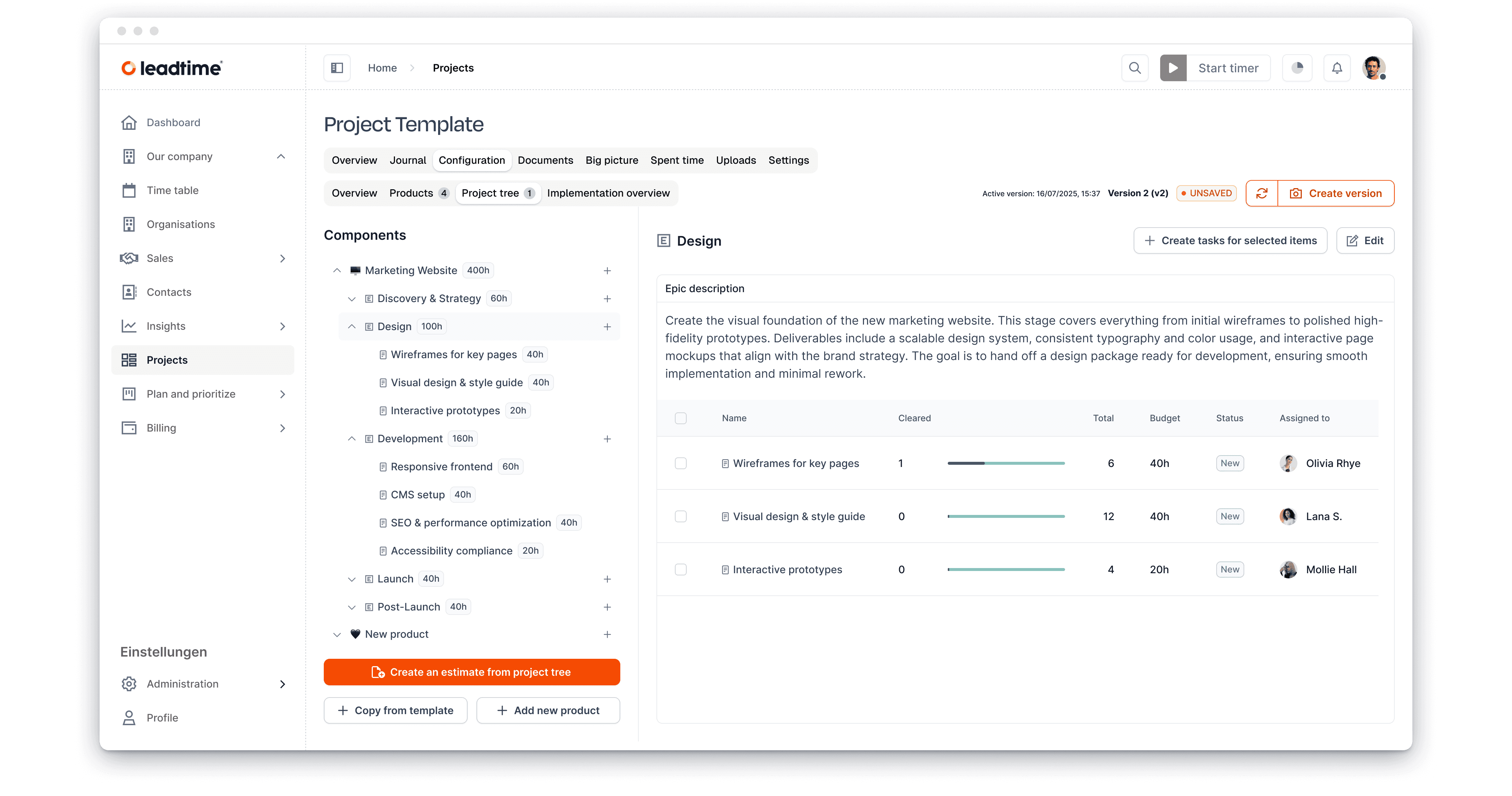
At Leadtime, we built exactly these four principles into one system. The Component Library provides standardized templates for every project type – with work packages, checklists, and acceptance criteria. New projects launch in minutes instead of days.
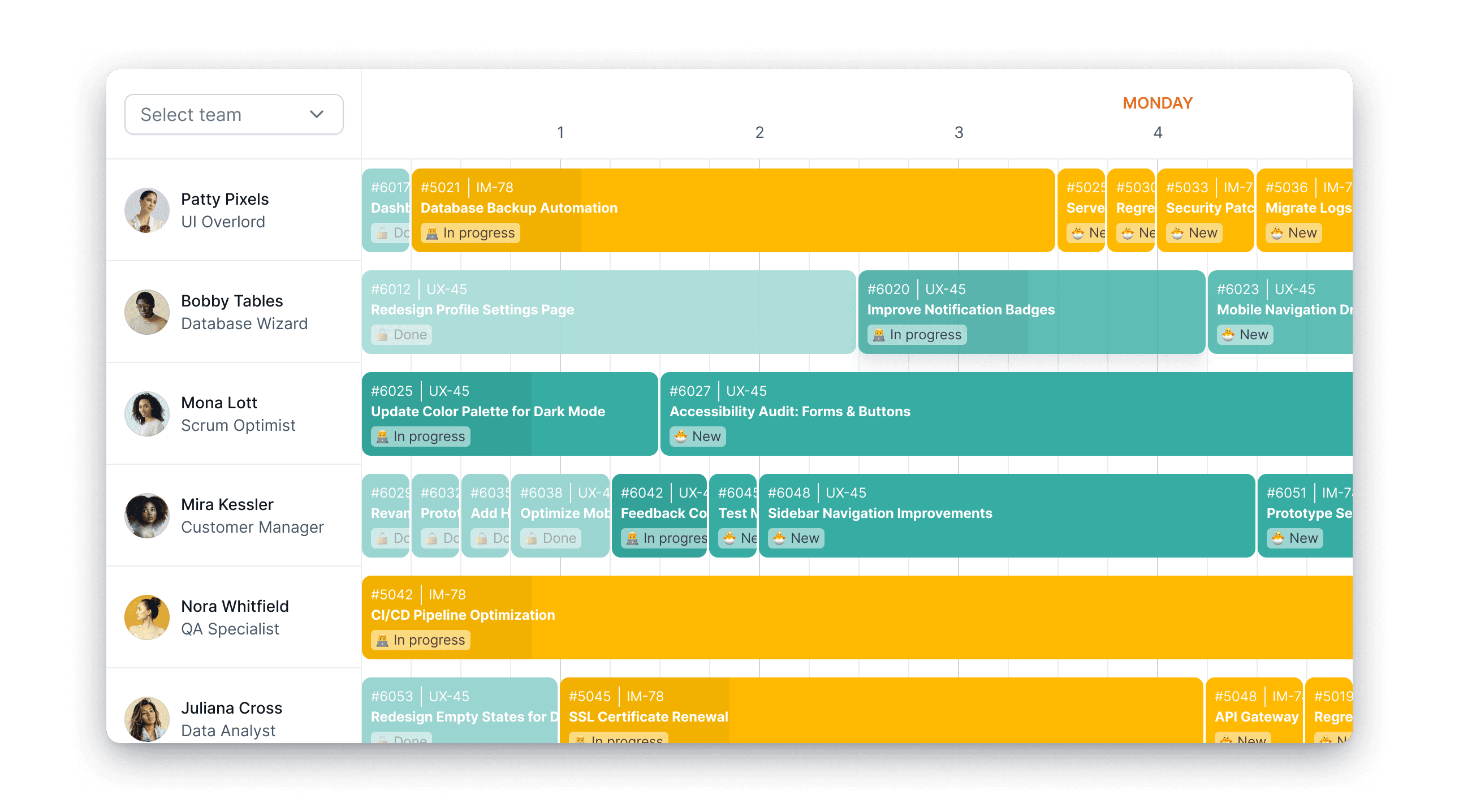
The Pipeline view makes capacity visible. At a glance: who's overloaded, where there's room, when the next customer can be slotted in. And the Customer Portal shows customers in real time which tasks are done, what's coming next, and when go-live is realistic.
A digital agency in Berlin – 28 employees, e-commerce implementations – cut their average onboarding time from 11 weeks to 6. In six months. Not by adding headcount. By adding structure.
Structures, Not Hustle
The most dangerous bottleneck in a growing company is usually self-inflicted. Not on purpose. But systematically.
Sales scales faster than delivery. That's normal. But when the response is to hire one more person, pull one more late night, build one more workaround – complexity grows faster than capacity.
The alternative isn't particularly exciting. It sounds like the opposite of startup energy: standardize, document, make things visible. Build processes that work without heroics.
But that's exactly what separates companies that hit a ceiling at 30 people from those that are still growing at 100.
Delivery isn't a cost center. Delivery is the lever that determines whether growth actually lands.
We built Leadtime because we had this problem ourselves. Not because we were smarter – but because the spreadsheet eventually had more rows than answers.