 ClientsOpportunities, quotes, product catalogue
 ProjectsPlanning, tasks, sign-off
 ServiceHelpdesk, tickets, retainers, assets
 TeamPeople, absence, time
 MoneyInvoices, e-invoicing, insights
 AgentsLeadtime Agent, your own agents, automation
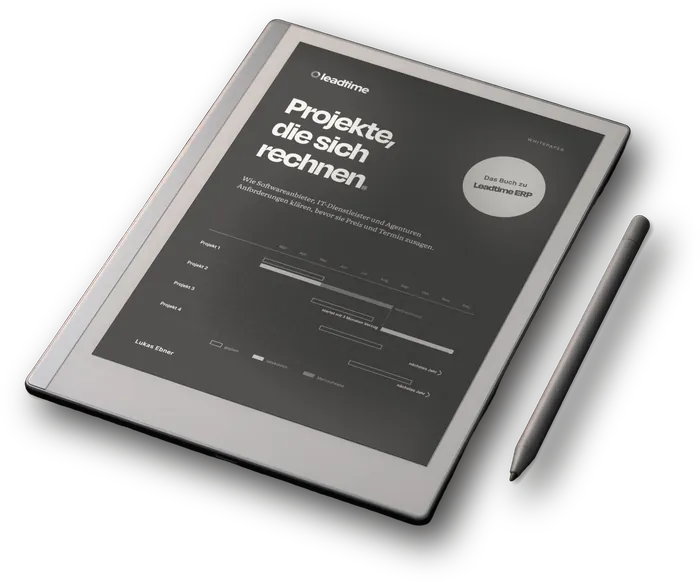
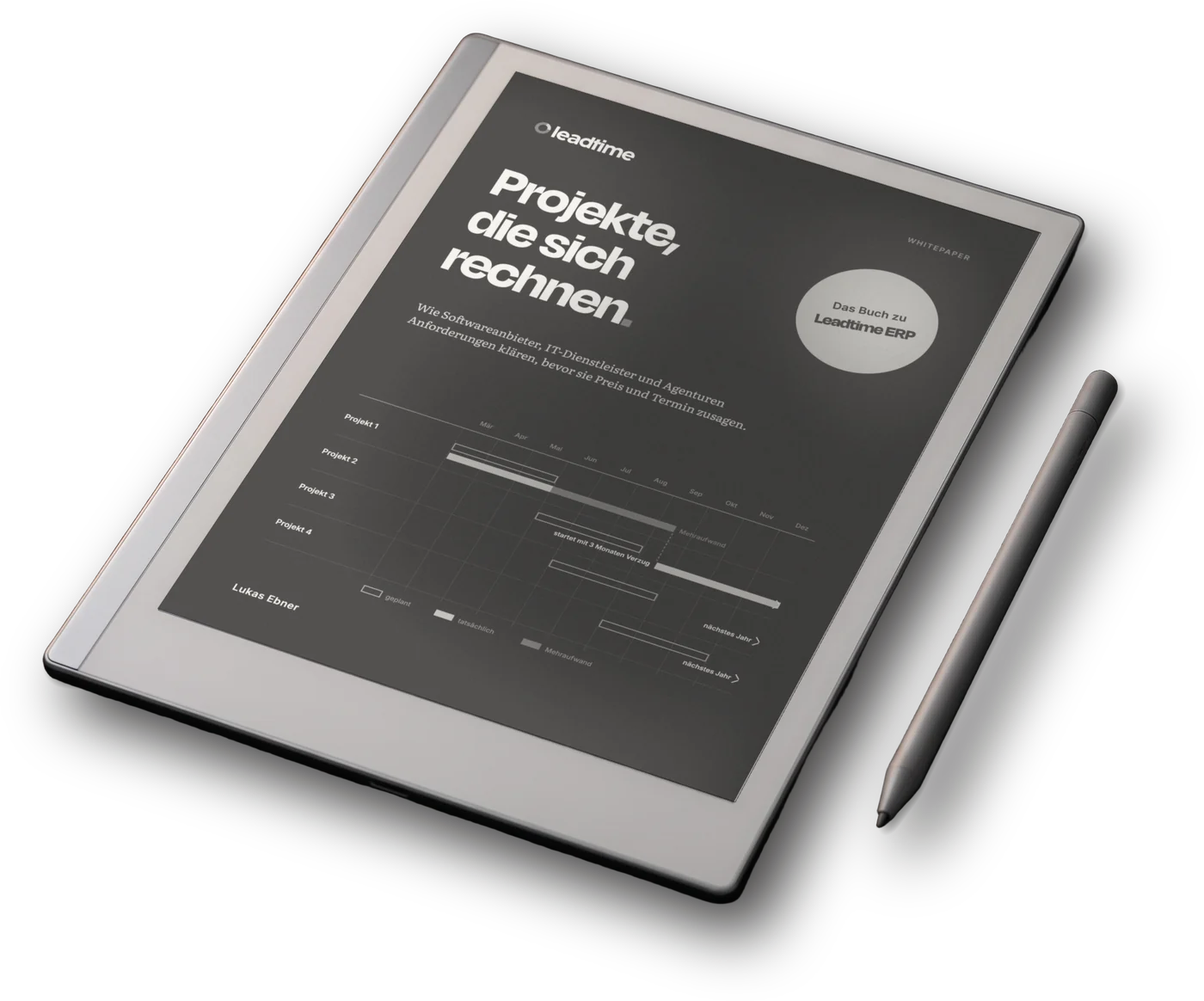
Projekte, die sich rechnen.The new book by Lukas Ebner, in German
Know what a project costs before you commit to a price and a date.
For software vendors, IT service providers and agencies. Following one case from start to finish, I show where projects go wrong before they even start. You will see how to break requirements into packages you can estimate and turn recurring services into a catalogue. That catalogue produces quotes that hold up. The book is written in German.
What you will learn
Six things you can do differently from your next quote on.
- 01
See where a project goes wrong
Six points between tender and delivery where a good job turns into a loss. Most of them come before the first working day.
Chapters 1 to 4 - 02
Work out what delay costs
Margin, lost revenue, cash flow and the projects waiting behind. As a model calculation with all assumptions shown.
Chapter 2, appendix B - 03
Break down a requirement
Behind “The platform must be multilingual” there are twelve questions. Three of them drive the effort. That is how you get to an estimate you can stand behind.
Chapters 5 and 7 - 04
Write the specification in three steps
Structure it, close the gaps in conversation, write it down precisely. With exclusions, client responsibilities and assumptions that prevent most disputes later on.
Chapter 8 - 05
Give an indicative quote first, then a binding one
Name a price early without carrying the risk alone. And plan dates around four milestones that actually hold.
Chapters 6, 9 and 10 - 06
Turn your services into a catalogue
Building blocks with a questionnaire that produce the quote, the specification and the tasks. With a plan for your first building block in 30 days.
Chapters 11 to 15 and 24
In a few places I show how we solved this in Leadtime. Most chapters work without Leadtime too.


The problem
A dream client, a spreadsheet with 48 rows and, nine months later, the crisis meeting.
The book follows Hanselink, a software vendor for insurers, through a job that looked good. In the final round they gave a discount. “Multilingual” ended up meaning four languages and every template. The CRM interface did not even exist yet, and in June the only person who understood it handed in his notice.
Each of these decisions was reasonable on its own. Together they sank the project and dragged three follow-on projects down with it. Hanselink is made up; I have heard the story in many variations.
What it looks like
The first four pages of chapter 1.
This is how the Hanselink case begins. Typeset for 10-inch readers: every page fills the screen without zooming. Click a page to leaf through.
What is inside
Five parts, 24 chapters, an appendix to take away.
IWhy projects fail before they begin
- 1How a dream client becomes a loss-making project8
- 2Price and date are fixed, the scope is not19
- 3Why clients ask for fixed prices30
- 4Three bad ways out when the scope grows38
IIClarify requirements before you commit
- 5Why a requirements list is not enough for a quote45
- 6Agile delivery, fixed quote: the hybrid model51
- 7Break a requirement into packages you can estimate56
- 8Write the specification in three steps64
- 9Give an indicative quote first, then a binding one71
- 10Plan dates that hold77
IIIRecurring services as a catalogue
- 11Most projects repeat themselves83
- 12Turn a service into a building block88
- 13Configure by questionnaire instead of estimating again96
- 14Quote, specification and tasks from one source102
- 15What the Leadtime Agent can do with a catalogue107
IVDeliver without renegotiating
- 16From specification to tasks without follow-up questions113
- 17Plan capacity before it runs short117
- 18The client sees where the project stands122
- 19Every change has a price before it is built127
- 20Acceptance against test cases, not gut feeling132
- 21Invoices straight from the project137
- 22Estimate more accurately with every project142
VA year later, and your first step
- 23A similar job, a year later148
- 24Your first building block in 30 days155
AAppendix
- AChecklists to take away160
- BThe model calculations in full163
- CGlossary165
- DAbout the author, imprint167
Who it is for
For companies that have to commit to a price and a date before everything is clear.
Software vendors
You set up and adapt your product for every client. Every rollout threatens to turn into a consulting project. The case in the book takes place at a vendor like that.
IT service providers and system houses
You receive requirements as a spreadsheet and are expected to turn them into a fixed price. The book shows which questions to ask first and how to get the answers into the quote.
Agencies and consultancies
Your projects are more alike than they seem. Boxes in the book show what applies to agencies too and where things differ.
- Written for
- Management
- Sales
- Project management
- anyone who writes quotes and specifications
You will find little that is new if you only ever bill by effort and never commit to a fixed price or a date.

Who wrote it
Lukas Ebner
Founder and managing director of Leadtime Labs GmbH in Regensburg, Germany. He knows the project business from around 15 years at a digitalisation service provider for energy utilities, which he helped build without outside capital from a small start-up into a company with more than 50 employees. That is where Leadtime started.
The first edition of this book was called “So gelingt die Punktlandung!” (“How to land on target”). Many readers wrote to him afterwards to say they recognised the story in the first chapter, almost exactly. The new edition is considerably longer.
“What is missing here, what do you see differently? Write to me. I read every email myself.”
From the foreword, hello@leadtime.deNext step
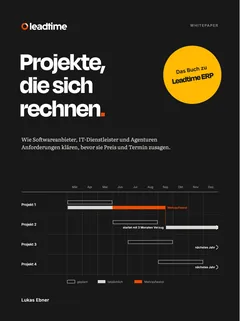
Projekte, die sich rechnen.
How software vendors, IT service providers and agencies clarify requirements before they commit to a price and a date.
Lukas Ebner
168 pages, PDF, free, in German

Frequently asked questions
What to know before you download.
What format is the book in?
A PDF at 157 × 210 mm. That matches the screen of common 10-inch e-readers, where every page fills the screen without zooming. You can read and print it just as well on a computer. Bookmarks in the PDF lead to every chapter.
How long is it?
168 pages in five parts with 24 chapters. Every chapter opens with one sentence on what you will learn and ends with a short summary. The appendix holds checklists, the model calculations laid open and a glossary.
What does the book cost?
Nothing. You give your first name and email address; the company is optional. After sending the form you get an email with a confirmation link. One click and you can download the PDF. We also email you the link to the book.
What happens to my data?
We store your first name, your email address and, if given, your company in order to send you the book. We only email you about Leadtime if you tick the second box. If you only requested the book, we delete your details after six months. You can unsubscribe at any time via the link in every email or by writing to hello@leadtime.de. Details are in our privacy policy.
Is this a brochure for Leadtime?
No. In a few places I show how we solved this in Leadtime, and part III has a chapter on the Leadtime Agent. The method itself works with any tool, including spreadsheets and text documents.
Are the case and the figures real?
Hanselink, the client Auenhof and all the people are made up. All amounts are model calculations whose assumptions are listed in appendix B. They are not measured results from clients, and they are not promises.
Is there a printed or an English edition?
At the moment the book is only available as a PDF and only in German.