
 ClientsOpportunities, quotes, product catalogue
 ProjectsPlanning, tasks, sign-off
 ServiceHelpdesk, tickets, retainers, assets
 TeamPeople, absence, time
 MoneyInvoices, e-invoicing, insights
 AgentsLeadtime Agent, your own agents, automation

The operating system for IT service providers and agencies.
Sales, projects, service and invoicing in one system, with AI agents that take over the routine. Your team gets more done, and the cost per job goes down.
The problem
Lots of tools, but no clear view.
Sound familiar? You have a tool for everything: sales, projects, tickets, time and invoices. And still you are poking around in the fog. Where does the job stand, who is fully booked, what has already been billed? In the end you run your company on gut feeling.
The solution
Leadtime is different.
Instead of many programs, your team works in one system. Sales, projects, service, time and invoices hang off the same job. Every piece of information is created once and visible to everyone, people and agents alike.
That changes how you work: nobody searches between programs any more, no handover gets lost, and you run your company on numbers instead of gut feeling.
One system. Everyone on the same job.
Image: logos of many programs float about, with six colleagues in between who take turns asking where something is. As you scroll on, the logos come together into the Leadtime ring, and the six line up around it.






What it looks like
A walk through the real app, in three minutes.
Video transcript
One system, people and agents
Projects and ongoing support are what an IT service company lives on. Leadtime is the system for it: selling, delivering, supporting and billing, in one place. People and agents work in it together. Agents are not an add-on, they are built in everywhere: they get tasks, know your projects and book their time like anyone on the team.
Sell
Clients, contacts and sales opportunities sit in sales, phase by phase. Quotes are built from components with hours and price, and the Leadtime Agent knows where everything stands when you ask it.
Deliver
Once the quote is signed, it becomes the project. The work packages become tasks. Every task can be assigned to a colleague or to an agent, with its own account and its own role. Planning happens in the pipeline, week by week, for the whole team.
Support
Support continues after the project. Requests arrive as tickets in the same system. Agents can take over here too. What an agent does shows up under its own name on the ticket.
Team
Bookings are made where the work happens: on the task, on the ticket, on the project. That goes for people and agents alike. Whatever an agent may do is decided by its role.
Invoice
Billing draws on the same source. At the end of the month everything is ready: project work, support hours, express quotes and subscriptions. Review, adjust and invoice, without hunting for anything.
Automate
Recurring work becomes an automation: a trigger, an instruction, and the agent does it again every week. Leadtime is one system in which your team and your agents work together. From first contact to invoice.
Why it is faster
This is how fast Leadtime can speed up your business.
Three levers work together. Switch them on one after the other and see which part of your day-to-day work gets faster, and by how much.
Switch on the levers

up to10×faster*Model calculation, explained in the figures below
Today: one process, many tools
Every handover, every bit of retyping and every follow-up question costs time.
Example: handover from sales to delivery
The deal you won already is the project. Nobody retypes anything.
Example: writing an invoice
The invoice is built from logged work. Your team only reviews it.
Example: resolving a routine ticket
An agent resolves the ticket and logs the time. Your team reviews the fix.
* Model calculation: times per process from our calculator; “up to 10×” applies to routine work. More on this in the figures below.
What's inside
Six areas, one system.
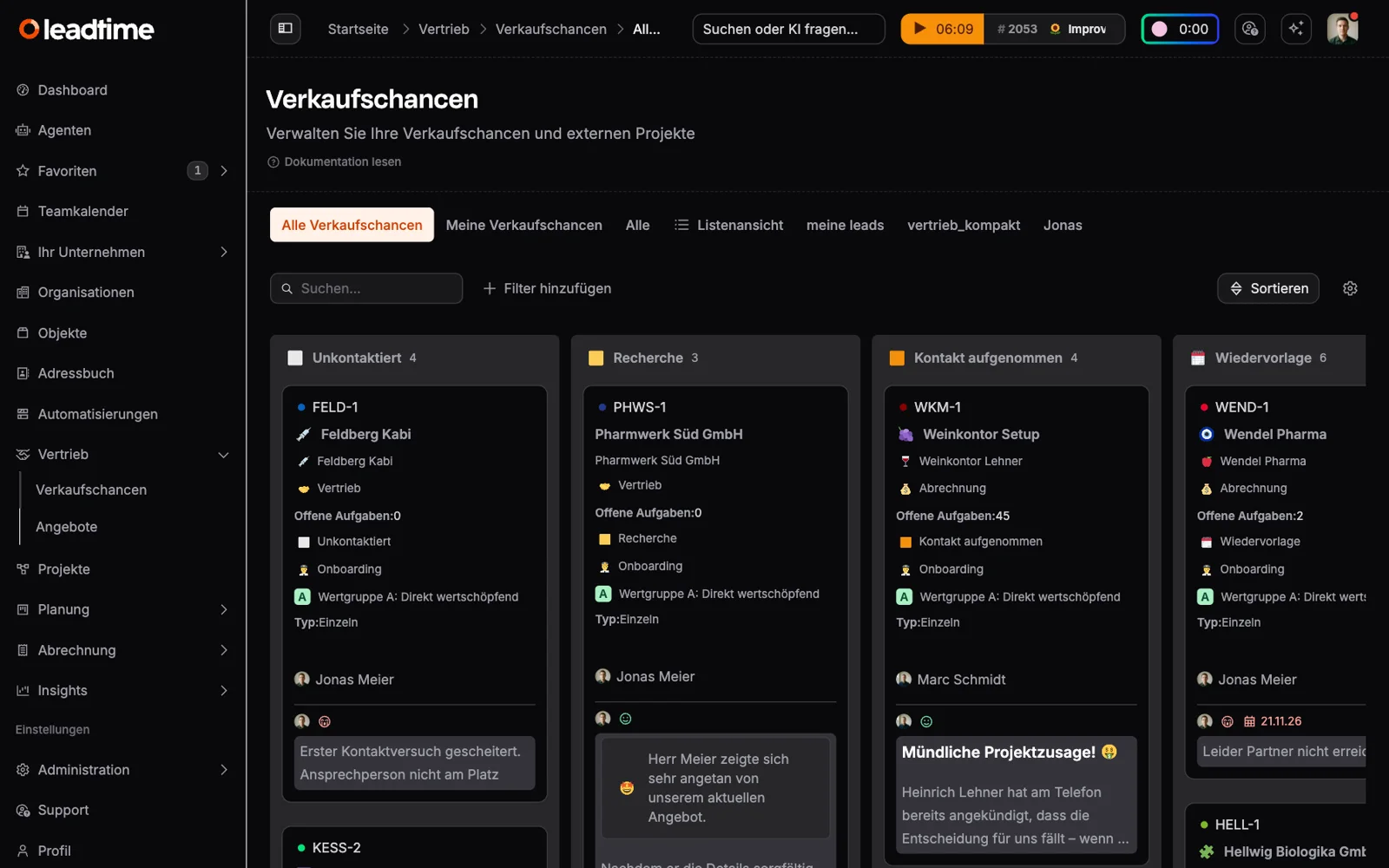
Customers
Customer relationships are your most valuable asset. Leadtime records every touchpoint, from the first conversation to years of support.
- Sales opportunities as a pipeline
- Journal with every email and call
- Contacts and organisations
- Quotes straight from the opportunity
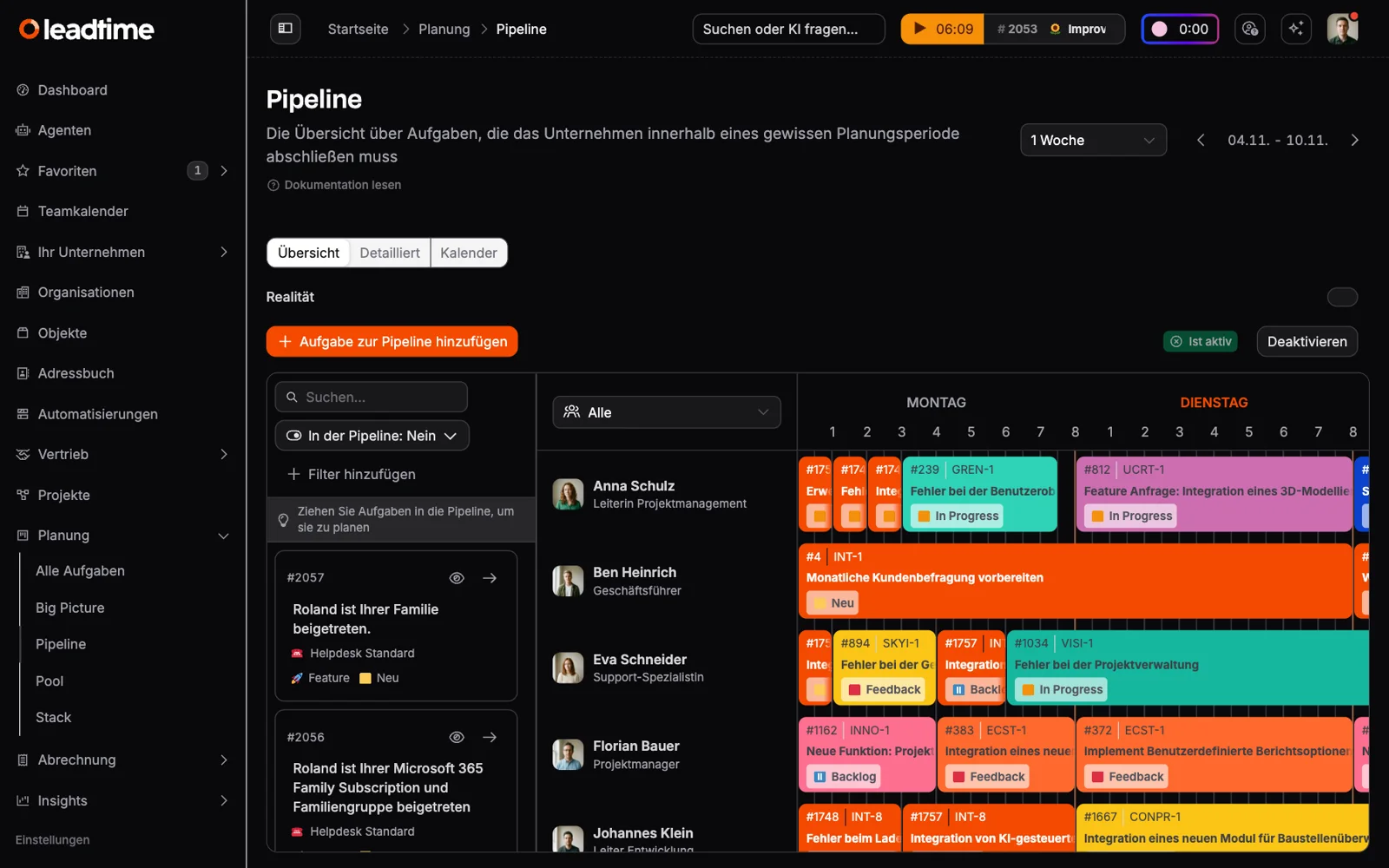
Projects
Projects decide your margin. Leadtime turns your services into products and plans delivery across the whole team.
- Service catalogue with questionnaires
- Quote, specification and tickets in one go
- Pipeline and capacity planning
- Acceptance tests inside the project
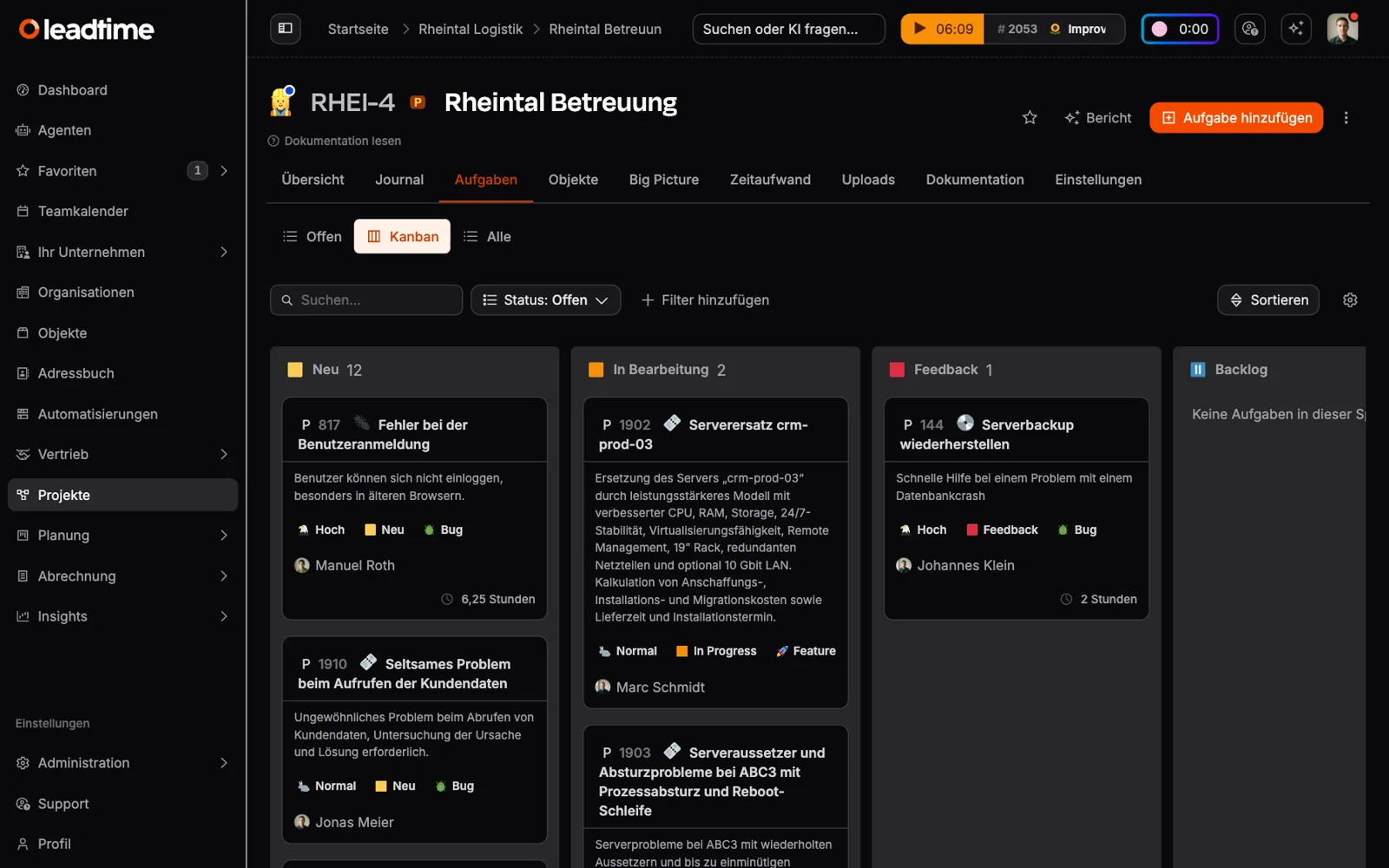
Service
Good service is part of your product. Leadtime turns every request into a ticket while your customers just keep emailing.
- Helpdesk with customer portal
- Tickets as kanban and list
- Quotas and support contracts
- Every minute billable
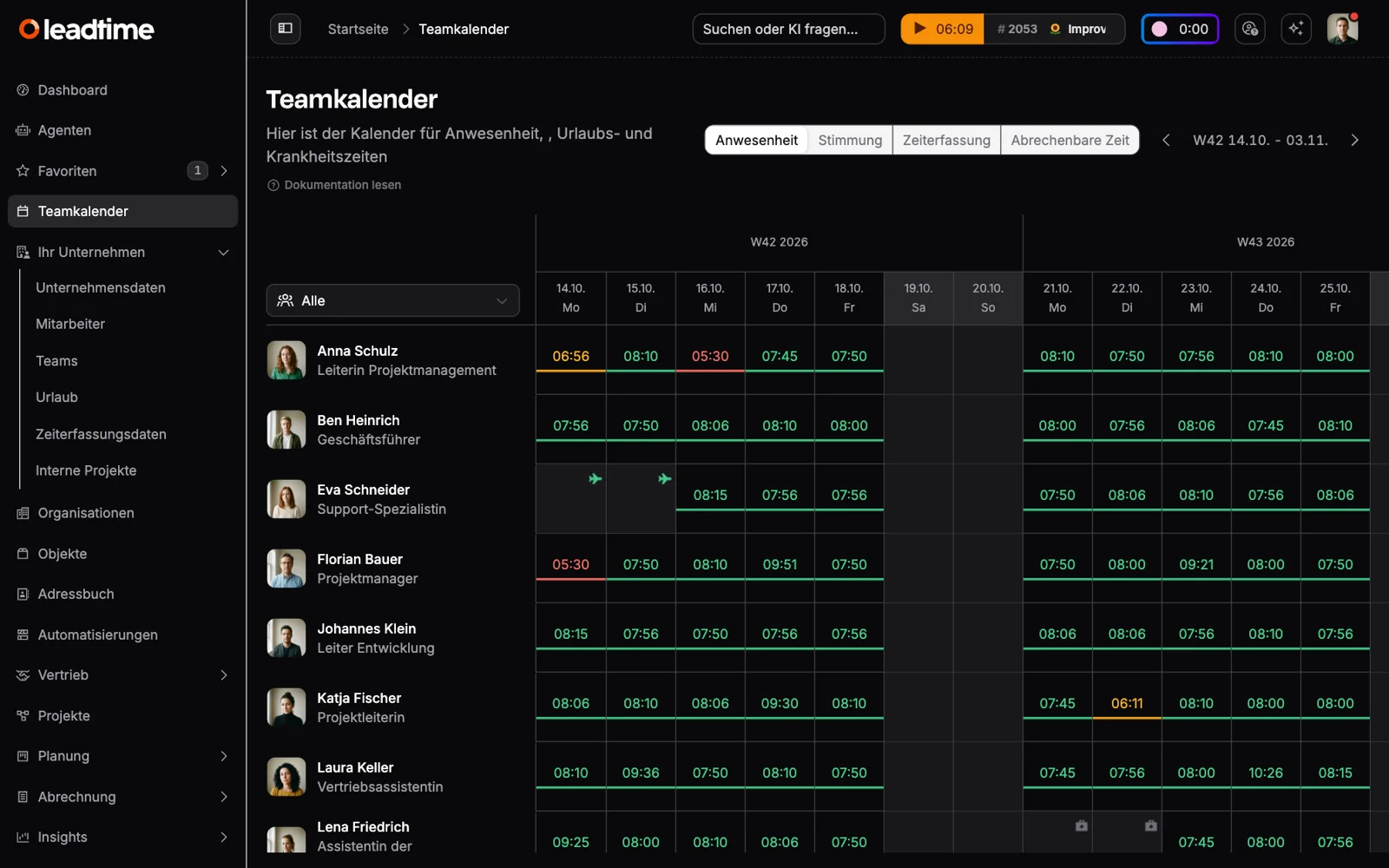
Team
Your people are your biggest investment. Leadtime shows who is in, who is fully booked and where the time goes.
- Team calendar with attendance
- Time tracking without timesheets
- Leave, sick days, overtime
- Billable time per person
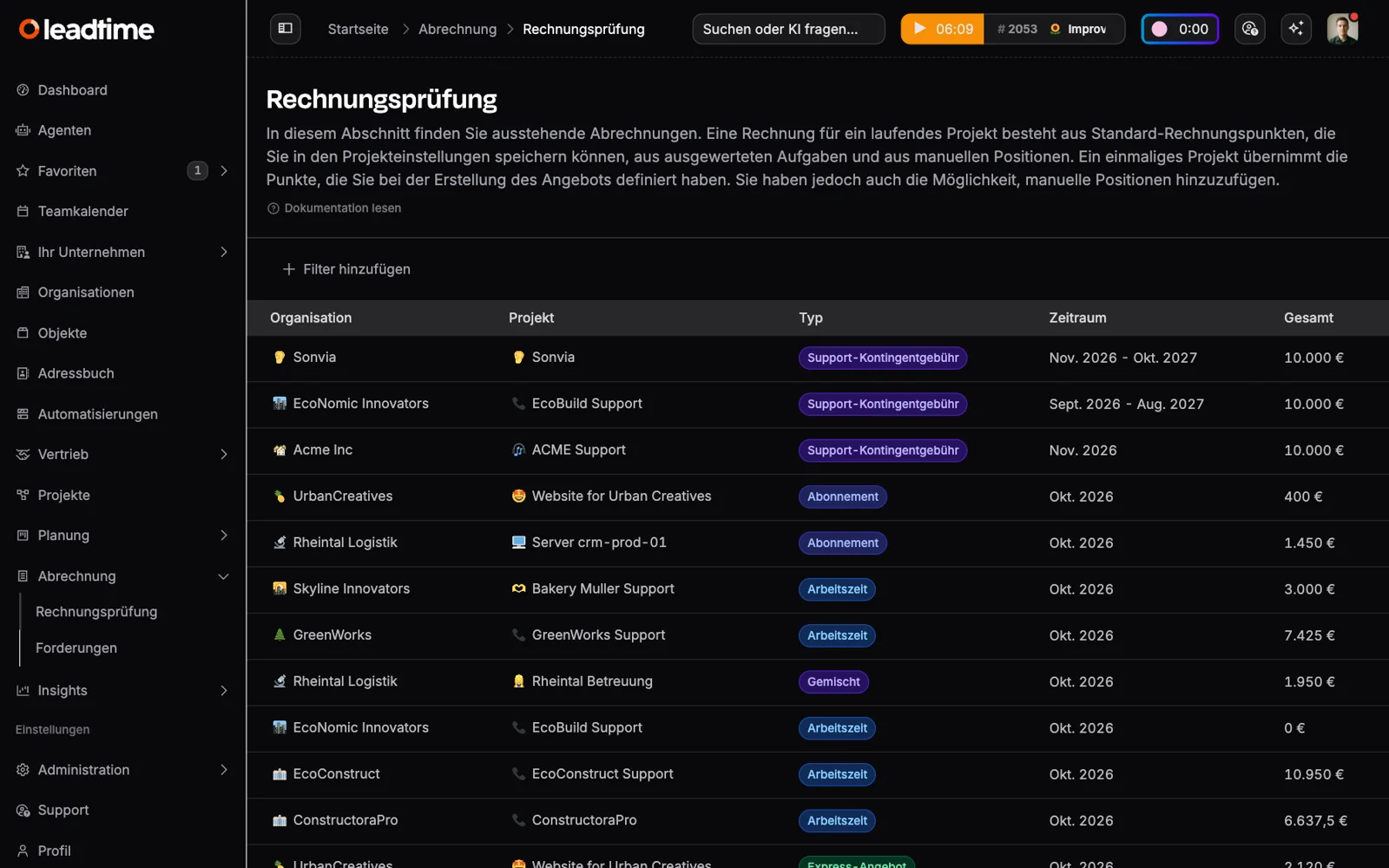
Finance
Every customer is billed differently. Leadtime ties work firmly to billing so nothing slips through.
- Any pricing model: hours, flat fee, subscription, quota
- Invoice review from booked work
- E-invoices and dunning
- Revenue and margin per customer
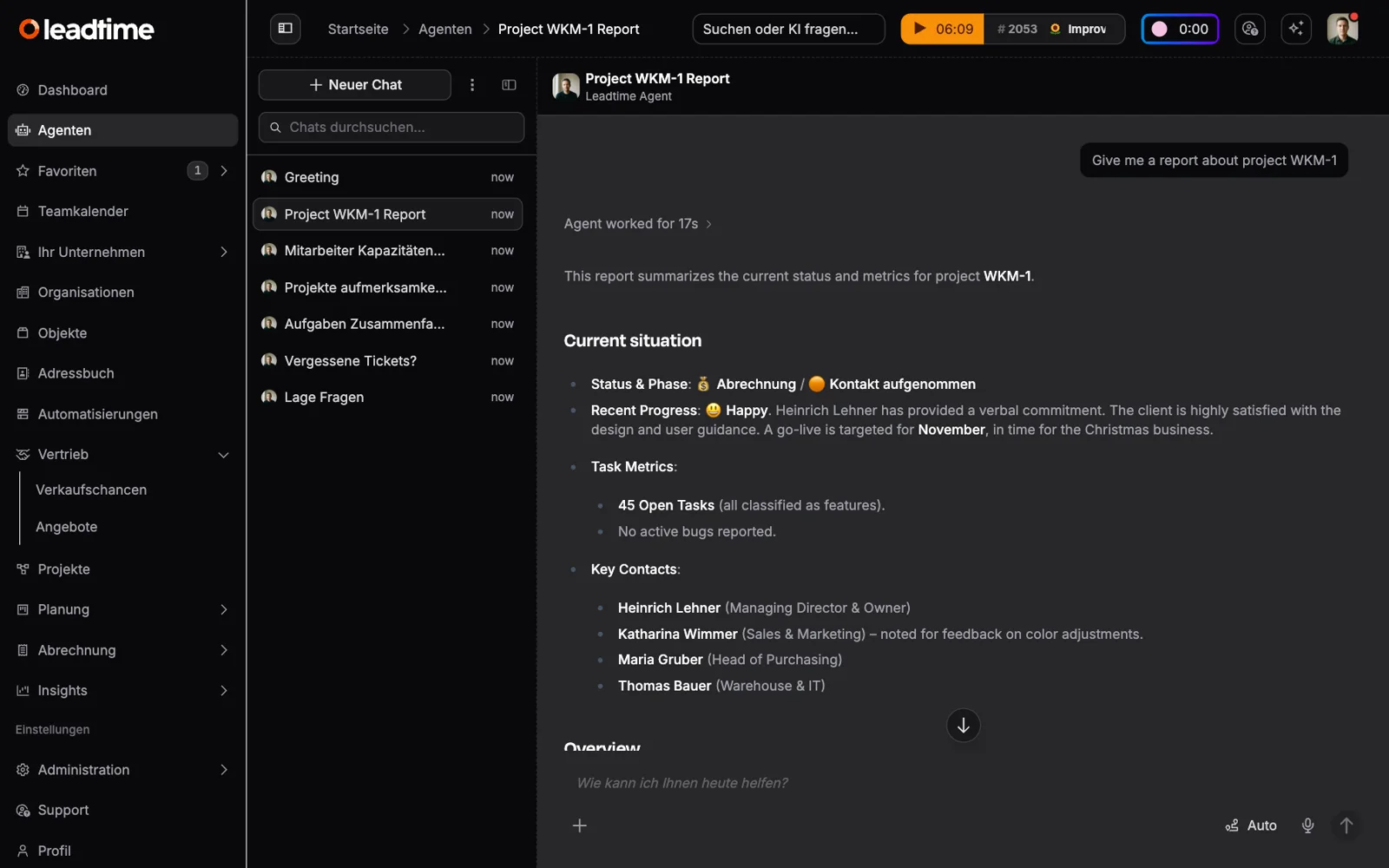
Agents
AI works inside Leadtime, not alongside it. Agents have roles and permissions and work traceably with your team.
- Leadtime Agent in chat
- Your own agents via MCP and API
- Automations on schedule and event
- Permissions and log per agent
Prefab house, not patchwork.
Leadtime is the complete infrastructure for professional services firms: services with lots of customisation, lots of support and long, close customer relationships. One system replaces around 20 tools, from CRM and project planning to helpdesk, time tracking and billing.
At the push of a button you have enterprise-grade infrastructure, even if you are just starting out. It grows with you, up to several hundred employees. You set it up yourself, in a chat with the Leadtime Agent, instead of starting an ERP project with consultants.
How switching worksWhat you save
This much working time is freed up.
Example: a web agency with 20 employees. Agents resolve routine tickets, invoices come from booked work, and handovers stay in the same job.*
3,260hours freed up a year
2.0full-time roles of work freed uparound €153,000 less in staff costs a year
+68%more EBITat a 10% margin today, after the cost of Leadtime
* Model calculation with our calculator, medium assumptions; “up to 10× faster” applies to routine work, such as a ticket an agent resolves and your team reviews, and is not a promise of results.
How Leadtime solves it
From first contact to long-term support, in one system.
Each step works with what the previous one already knows. The result is a documented client relationship that your client and your team can rely on.
New on the blog

AI agentsNovember 10, 20268 min
AI agents in daily work: the real issue is control
Support tickets through to deployment, project work over MCP, invoices from the system. What goes wrong is rarely the model. It is shadow AI and costs nobody sees.
Read on
Where to read on.
 The whole app on one map.Every area and how they connect, drawn as a transit map.See the overview
 Reasons for Leadtime.What changes when sales, projects, service and invoicing are one system.Read the reasons
 Not an ERP project. A move.Upload your data, connect your inbox, set up the rest in a chat with the Leadtime Agent.See how to switch
 One price per user, every area included.€29 per user per month, billed annually, with a free 30-day trial.See pricing
Next step
Let us show you on one
of your jobs.
30 minutes, one real job from your day-to-day work. Not a sales pitch, but your own process in Leadtime.