
 ClientsOpportunities, quotes, product catalogue
 ProjectsPlanning, tasks, sign-off
 ServiceHelpdesk, tickets, retainers, assets
 TeamPeople, absence, time
 MoneyInvoices, e-invoicing, insights
 AgentsLeadtime Agent, your own agents, automation


Ten reasons why your company earns more with Leadtime.
Leadtime brings sales, projects, service, team and invoicing into one system, and agents work inside it. The chaos becomes something you can plan, the same work needs fewer people, and your EBIT goes up.*
What is different
The ten reasons at a glance.
Pick a reason to jump straight to it. From every reason you can come back here.
 01Chaos becomes a timetableView
 02One system, not three silosView
 03One process, not a relay raceView
 04Work turns into moneyView
 05A building that grows with youView
 06Agents, in good orderView
 07Projects from building blocksView
 08Move in, don’t buildView
 09Everyone works their wayView
 10More EBITView
Project chaos becomes a timetable.
In project business, everything is always on the move. You start with incomplete requirements, take on jobs because you need the revenue, and spend the day reacting. That creates dependencies right across the company that nobody can see.
Your team is working on project A, and project B is due to start. But A takes longer, and the team stays tied up. B starts later, C slips, and the campaign for the app launch moves with it. One delay becomes a whole chain, and what remains is the feeling that everything is getting on top of you.
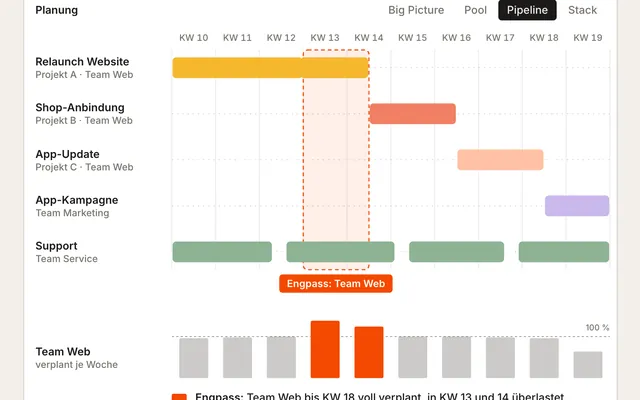
Leadtime puts all projects, tickets and people into one plan, like a train timetable. Week by week you see who has hours free and where someone is overloaded. You spot the bottleneck before the next deadline slips, and you see where you can save time.
Coordinating, searching, retyping per person per week +1,200 hfreed up a year, with 20 people*Image in three steps: first, five coloured lines, one per project, are tangled into a knot, with triggers such as incomplete requirements and a new job in between. Then the projects lie side by side as bars over ten weeks. Project A, a relaunch, takes a week and a half longer, the web team stays tied up, and the shop integration, the app update and the campaign for the app launch slip back. The spot is marked as a bottleneck. Finally everything sits in the Leadtime plan, with the web team’s workload per week below it, overloaded in weeks 13 and 14.
Projects, team, money: three silos, one company.
In many firms, projects, team and money are separate worlds. Project managers don’t know the budget, accounting doesn’t know what was delivered, and nobody knows whether the team can keep its promises.
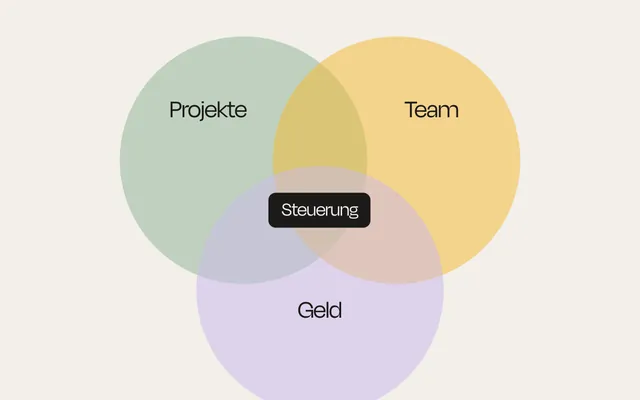
In Leadtime the three are connected, and every decision shows its effect on all of them. That is what we mean by control.
+60 h a year*Management report: 6 → 1 h a monthImage: three circles for projects, team and money stand far apart, each with its own question. Then they slide over each other. In the middle it says control, and below it the question whether you can take on the job, answered from capacity, deadline and budget.
From enquiry to support: one process, not a relay race.
Winning the client, requirements, quote, project, invoice and support all run in one system. Nothing is handed over, retyped or chased up. The result is one lean process you can follow from start to finish.
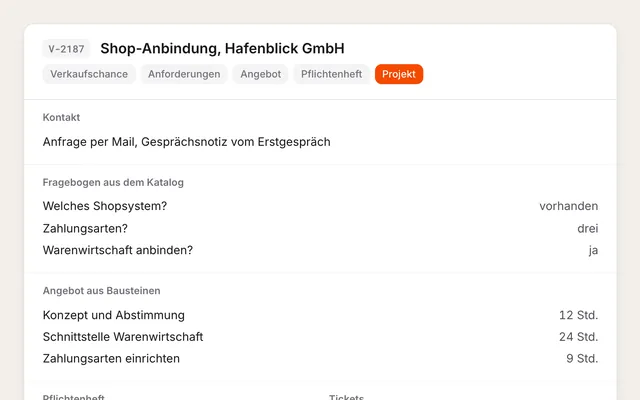
- The enquiry becomes an opportunity.Contact, call notes and needs sit on the client.
- The questionnaire comes from your catalogue.Each service comes with the questions you always ask.
- The answers turn into the quote.Built from the blocks and hours of your services.
- Specification and tickets from the same data.What is in the quote is also in the specification and the tickets.
- The yes already is the project.Nobody retypes anything. Invoicing and support hang off the same job.
Image: a single job grows step by step: opportunity, questionnaire with answers, quote with blocks and hours, specification and tickets, and finally the project. Everything stays in the same job.
Not a ticket system. A system where work turns into money.
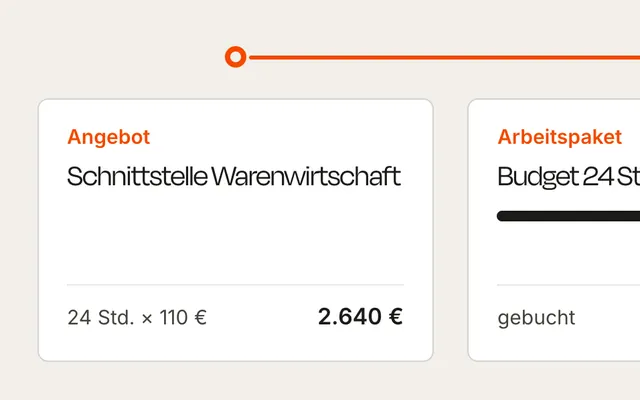
Money runs through everything: the quote is priced from the hours of its building blocks, the budget sits on the work package, and time logged on a ticket counts against the retainer, agents’ time included. At the end of the month everything is waiting in invoice review. That is why Leadtime is more than project management.
Image: an orange thread connects four stations: the quote with hours times rate, the work package with its budget, a ticket with logged time counting against the retainer, and invoice review with the finished lines.
What you save
An invoice in 5 minutes instead of 40.
The invoice is built from the logged work. Your team only reviews it, at 40 invoices a month.*
280fewer hours a year spent on invoices
8×faster per invoice40 minutes today, 5 minutes with Leadtime
Scalable infrastructure, from day one.
Instead of buying a separate tool for every department, you move into a finished building. Each floor is one area, and all of them run off the same service shaft, meaning the same data. A new team, a new line of business or a hundred more people do not mean a new tool.
- AgentsThe AI layer above everythingMore about agents
- InsightsReports and key figures from every floorMore in the overview
- MoneyFrom work done to invoiceMore about money
- ServiceTickets and support in day-to-day operationMore about service
- ProjectsPlan and deliver reliablyMore about projects
- ClientsFrom first contact to signed jobMore about clients
- TeamThe base: people, time, leave, workloadMore about team
Image: a cut-away office building with six floors and an orange glowing service shaft running through all of them. Floor by floor the lights come on, from the bottom up. At the end a small robot stands on the roof.







Agents across the whole company, but in good order.
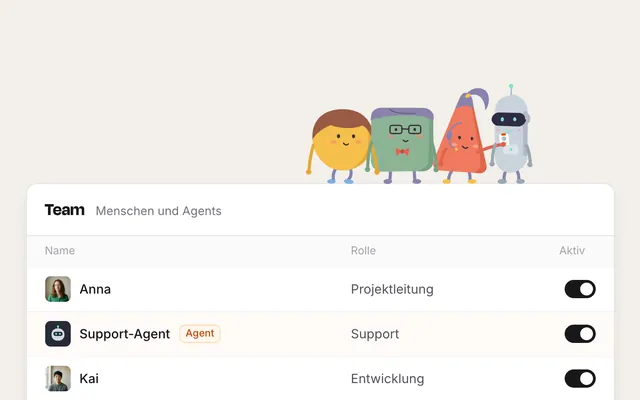
In many firms everyone uses their own AI in their own tool, and nobody knows what it is doing. In Leadtime every agent is a team member with a role. It works on tasks in the same system, across every area. Every step shows up in the history, and if you deactivate it, it is locked out immediately.
That keeps vibe coding under control too: the coding agent works on the task from the specification, not on a whim.
+1,040 h a year*Routine ticket: 20 → 2 min, up to 10×; plus delivery work taken on by agentsImage: a team list where agents sit among the people, each with a role and a switch to deactivate it. A group of figures with a small robot stands on top of it.
 Anna
 Kai
 Laura
Six ways agents can work with you
- Leadtime Agentbuilt in, in the chat next to every view
- Automationsa job on a schedule or an event
- MCPyour AI tool works directly in Leadtime
- Coding agentsCursor in the cloud or Claude as a managed agent
- Your own agentswith access tokens and skills
- Self-hostedvia signed webhooks and the session API
Projects become a construction kit.
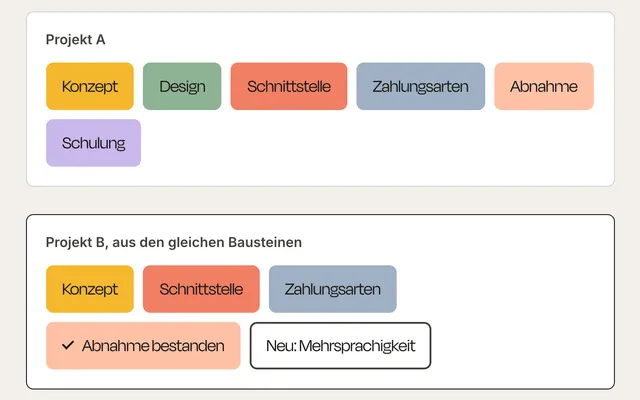
Every project is different, but much of it repeats. Leadtime turns that into building blocks with work packages, hours, tasks and test cases. The next quote is priced from the hours of your building blocks. And if you want to build a product of your own, you have already taken the first step.
+250 h a year*Quotes: 5 → 1.5 h per quoteImage: a first project is assembled from six coloured blocks. A second project then comes together faster from the same blocks, and one block carries the tick for a passed acceptance test.
An ERP for people who hate ERP.
No consultancy project and no months-long migration. You set Leadtime up in a chat with the Leadtime Agent. Your data comes in by CSV import, and Leadtime maps the columns with AI. You connect other systems through agents, MCP, the API, n8n or Zapier. Your accounting stays where it is.

What an ERP project often involves
- Consultants often set up the system.
- Data often moves in a migration project of its own.
- Warehouse and manufacturing come along, though you don’t need them.
- In the end the team often works around the interface.
Leadtime
- Set up in a chat with the Leadtime Agent.
- Employees, clients, contacts, projects and tasks by CSV, with columns mapped by AI.
- Connections via agents, MCP, API, n8n and Zapier.
- Only what service firms earn their money with: selling, delivering, supporting, invoicing.
Everyone works their way.
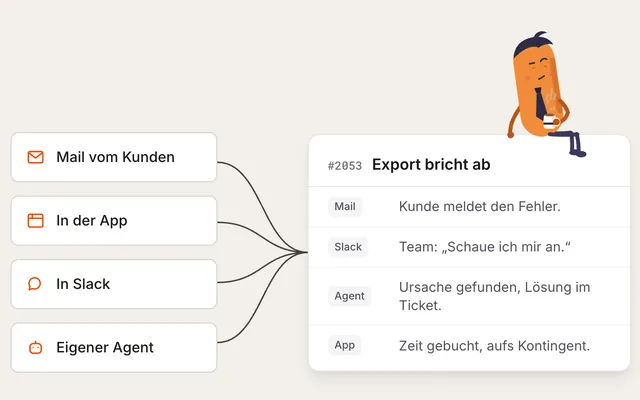
Your clients keep writing emails. Your team works in the app, in Slack or through its own agent, some without ever logging in. Leadtime stays in the background and brings together what belongs together. That is why it gets used rather than worked around.
+310 h a year*Catching up on timesheets: 20 → 5 min per person per week; emails become ticketsImage: four entry points, namely email, the app, Slack and your own agent, lead into the same ticket. A figure with a coffee sits on the edge of the ticket card.
Your EBIT goes up, and you grow without hiring at the same pace.
You can use the time freed up in one of two ways: do the same work with fewer staff, or deliver more jobs with the same team. Both raise EBIT. Example: a web agency with 20 employees.*
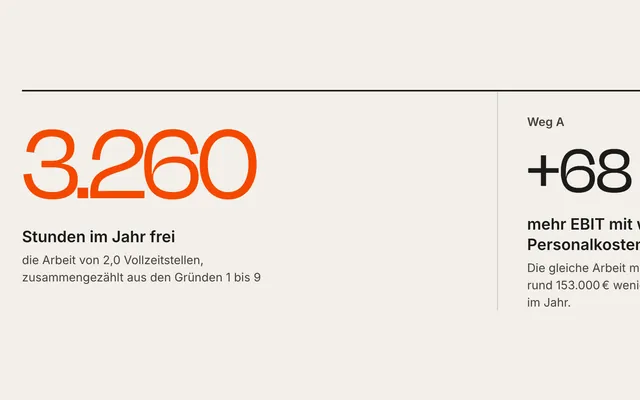
3,260hours freed up a yearthe work of 2.0 full-time roles, added up from reasons 1 to 9
Option A+68%more EBIT with lower staff costsThe same work with fewer people, around €153,000 less in staff costs a year.
Option B+98%more EBIT with more jobsThe same team delivers more, without new hires.
Both at a 10% margin today and after the cost of Leadtime.
* Model calculation with our calculator: web agency with 20 employees, “medium” scenario, all other values at default. The figures at each reason are the lines of this calculation. “Up to 10×” applies to routine work. Not a promise of results.
What managing directors ask
What managing directors ask us.
We already have five tools that work. Why switch?
The tools work, but each on its own. Leadtime replaces the ones for sales, projects, service, time and invoicing, and the handovers between them go away. Your accounting stays. The best way to show you is with one of your own jobs.
Can an agent just change things?
It may do what its role allows, and nothing more. You decide whether it works only on its own task or across the whole system. Every change carries its name, and if you deactivate it, it is locked out immediately.
Our tax adviser wants DATEV.
There is no DATEV export. Invoices go out as e-invoices, as PDFs with embedded data. Anything else you pass on via the API, Zapier or n8n.
Our clients write emails, not tickets.
And they can keep doing so. The email becomes a ticket, and your reply goes back from your own mailbox. Anyone who prefers can use the client portal.
You’re a young company. What if you’re gone one day?
We use Leadtime ourselves every day, with people and agents in the team. Through the public API and MCP access you can take your data out at any time. Our roadmap and changelog are public.
Will Leadtime bring us more work?
No, and we don’t promise that. Leadtime helps firms that have more work than they can cleanly deliver. Winning new clients is still up to you. Leadtime creates the capacity to deliver more work without having to hire for it.
Next step
Let us show you on one
of your jobs.
30 minutes, one real job from your day-to-day work. Not a sales pitch, but your own process in Leadtime.