
Written by
Lukas
•
•
Finance Management

At a restaurant, you pay after the meal. Kitchen wraps up, check arrives, payment processed — all within an hour. At a 15-person agency, things work differently: project completed March 14th, time entries backfilled on the 28th, invoice sent April 5th, payment received May 12th. Nearly two months between finished work and money in the bank. Restaurants run on what they call KOT — Kitchen Order Tickets. The order gets logged, prepared, and billed in one continuous flow. Lead time: minutes. At agencies, it's weeks.
That gap between delivering work and receiving payment? We call it the Invoice Gap. And it costs more than most agency owners realize.
According to a 2025 analysis by Glean and Numeric, only 28% of businesses hit their cash flow forecasts within 10% of target — the rest are essentially flying blind. Rarely because of a lack of clients. Usually because the process between work and payment has never been properly optimized.
The Invoice Gap — Your Invisible Cash Flow Problem
The invoice is the last thing anyone thinks about after a stressful project deadline. Understandable. But that delay has a price you can calculate.
What 10 Days of Delay Actually Cost
An agency billing $55,000 per month that sends invoices an average of 10 days late is permanently floating roughly $18,000 in unbilled revenue. At $110,000 monthly, that's $36,000. Not a loss in the traditional sense — but tied-up cash that's missing when payroll, contractors, or software licenses come due.
82% of business failures trace back to cash flow problems. Not bad products, not missing clients — timing.
That number comes from a widely cited U.S. Bank study, and it surprises people every time. Because most agencies with liquidity problems actually have enough work. They just bill too slowly.
What makes it worse: according to the same research, 88% of small and mid-sized businesses experience regular cash flow disruptions, but only 31% actively work on improving their processes. The other 69% hope it'll work out. Usually it does — until it doesn't.
DSO — The Metric That Decides Your Liquidity
DSO stands for Days Sales Outstanding — the average number of days between sending an invoice and receiving payment. Sounds dry. It's actually the most honest metric an agency can track.
Benchmarks That Sting
For IT service providers and agencies, reality often looks like this:
Under 30 days DSO: Rare. Agencies hitting this either have airtight processes or work on prepayment terms.
30–45 days: Solid. Where most well-organized teams land.
45–60 days: The gray zone. Cash reserves shrink, credit lines become relevant.
Over 60 days: Surprisingly common. Often not because of late-paying clients, but because the invoice went out three weeks after the project ended.
The good news: companies that automate more than half their accounts receivable processes reduce DSO by an average of 32%. That's not months of optimization — it's a process change with measurable results within a single quarter.
DSO Varies by Billing Model
Here's what gets overlooked: not every billing model creates the same Invoice Gap. Time & Material has different dynamics than a retainer, and fixed-price projects yet another.
With T&M, everything hinges on how quickly time gets logged. If team members backfill their hours at month-end, the Invoice Gap is structurally built in — the invoice can't go out until all entries are in. Retainers have better rhythm: monthly flat rate, predictable timing, steadier cash flow. But billing for out-of-scope work stays messy. And fixed-price projects? Often invoiced only after sign-off. What sounds like a clear trigger means, in practice, weeks of feedback loops before the invoice can even be created. A project that's done on March 1st can easily not get paid until May.
It gets most dangerous at agencies running all three models simultaneously. Each model has its own rhythm, its own rules, its own exceptions — and the person creating invoices at the end of the month has to keep all of it straight. Or in a spreadsheet that nobody else understands.
Anyone serious about keeping project finances under control needs to understand which billing model creates which cash flow rhythm. This matters even more for agencies that are scaling — growth amplifies every cash flow bottleneck.
Why Agency Billing Is So Complex (And Where Errors Creep In)
A typical IT agency doesn't have one revenue stream — it has five: project work billed by the hour, retainers, fixed-price projects, support contracts, and the occasional license resale. Each stream has its own billing logic, its own cycles, and its own pitfalls.
15 Hours a Month on Invoices Nobody Enjoys
An average 10-person agency spends 15 to 20 hours per month on manual invoicing. That includes: hunting down time entries, reconciling with project plans, checking budget thresholds, creating the invoice, getting approval, sending it, following up. At an internal hourly rate of $90, that's $1,350 to $1,800 in opportunity cost — every month.
The insidious part: that time is rarely tracked. Invoicing is admin work that happens between meetings, on Friday evenings, or in the first week of the new month. Nobody logs how long it takes. It feels like "a bit of admin." In reality, it's half a full-time job distributed across three people who all have better things to do.
One in five invoices contains an error. And every error triggers a correction loop that extends the Invoice Gap by another 5 to 10 days.
Anyone who's had an invoice bounced because of a missing PO number or hours that didn't match the proposal knows this. The problem isn't carelessness — it's complexity. Five revenue streams, each with its own logic, manually consolidated in a spreadsheet or a tool that wasn't built for this level of complexity.
And then there's the psychological factor: nobody loves writing invoices. No developer, no project manager, no account lead has ever woken up thinking: "Today I'm going to create really great invoices." The task gets postponed, delegated, forgotten — and every day of delay feeds directly into the Invoice Gap. What's annoying for a single project becomes a systemic weakness across a whole portfolio.

From Work to Cash — Without Detours
The solution isn't "type faster" or "be more disciplined about invoicing." The solution is closing the gap between operations and finance.
In a restaurant, billing is part of the service process. The waiter takes the order, the kitchen cooks, the waiter brings the check. Three steps, one workflow. At agencies, delivery and billing live in two separate worlds. The project team works in their tools, accounting in theirs. Between them lies a chasm of CSV exports, manual mapping, and the hope that nobody forgot anything.
What actually helps is a system that bridges this gap: logged hours and delivered work automatically flow into a central overview that finance teams can use as their billing foundation. No backfilling, no reconciling, no three-week lag between delivery and invoice.
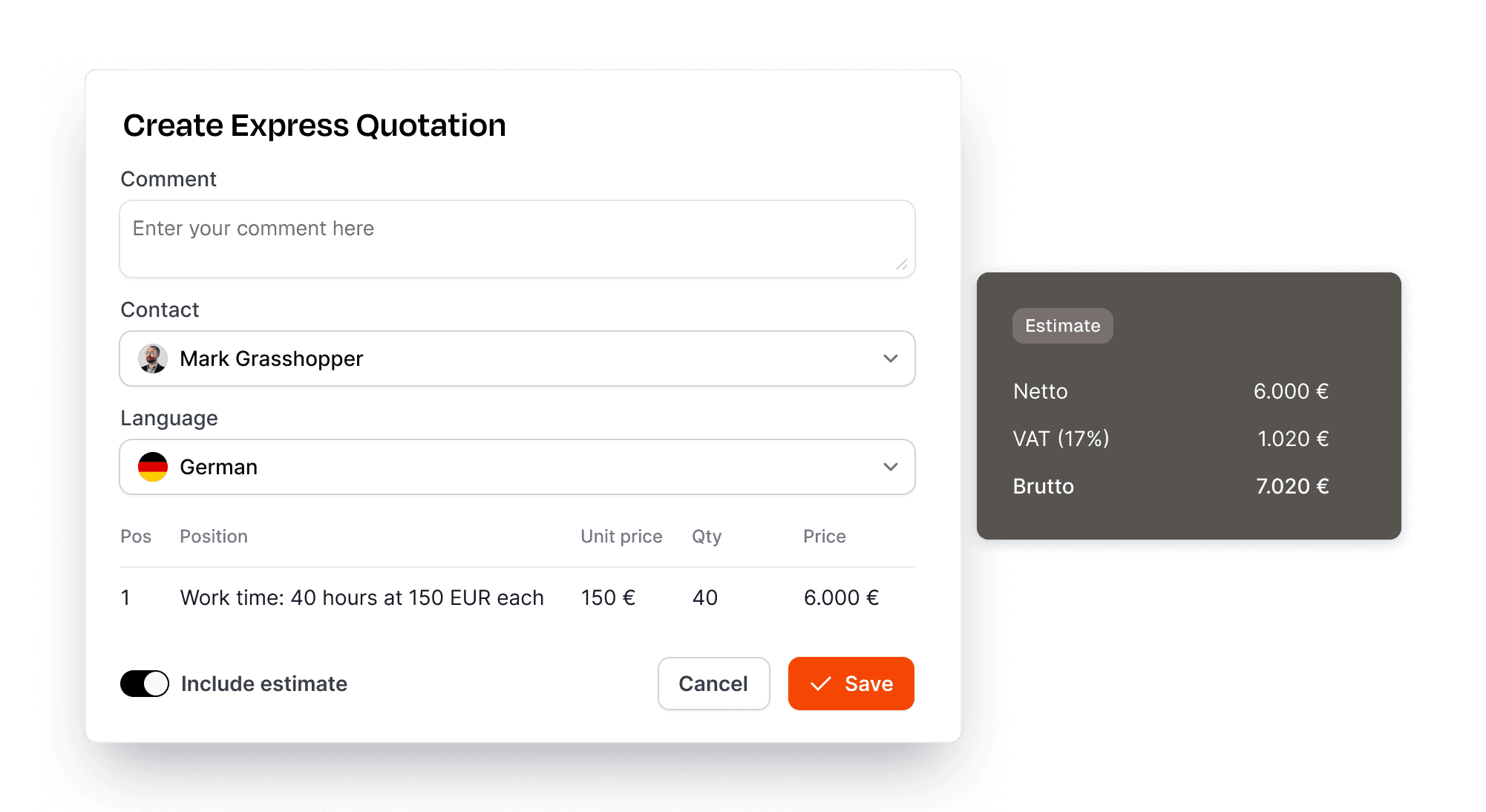
Shorter Intervals, Better Cash Flow
A principle from lean manufacturing: shorter cycle times produce better outcomes. Applied to billing, that means: invoicing weekly instead of monthly shrinks your Invoice Gap dramatically. Not every project lends itself to this, but for T&M contracts, weekly billing is a lever that surprisingly few agencies use.
Combining automatic work aggregation with shorter billing cycles can reduce DSO by 15 to 30 days — within three months. Those aren't theoretical projections; they're documented outcomes from AR automation in professional services.
One more lever that barely gets discussed: overdue management. Many agencies send invoices and then hope. No systematic follow-up, no automatic reminder after 14 days, no escalation process. But the data shows: the earlier the first reminder, the shorter the payment period. A friendly reminder on the due date isn't an affront — it's professional. Anyone with properly structured client support and contract processes can automate overdue alerts without it feeling like collections.
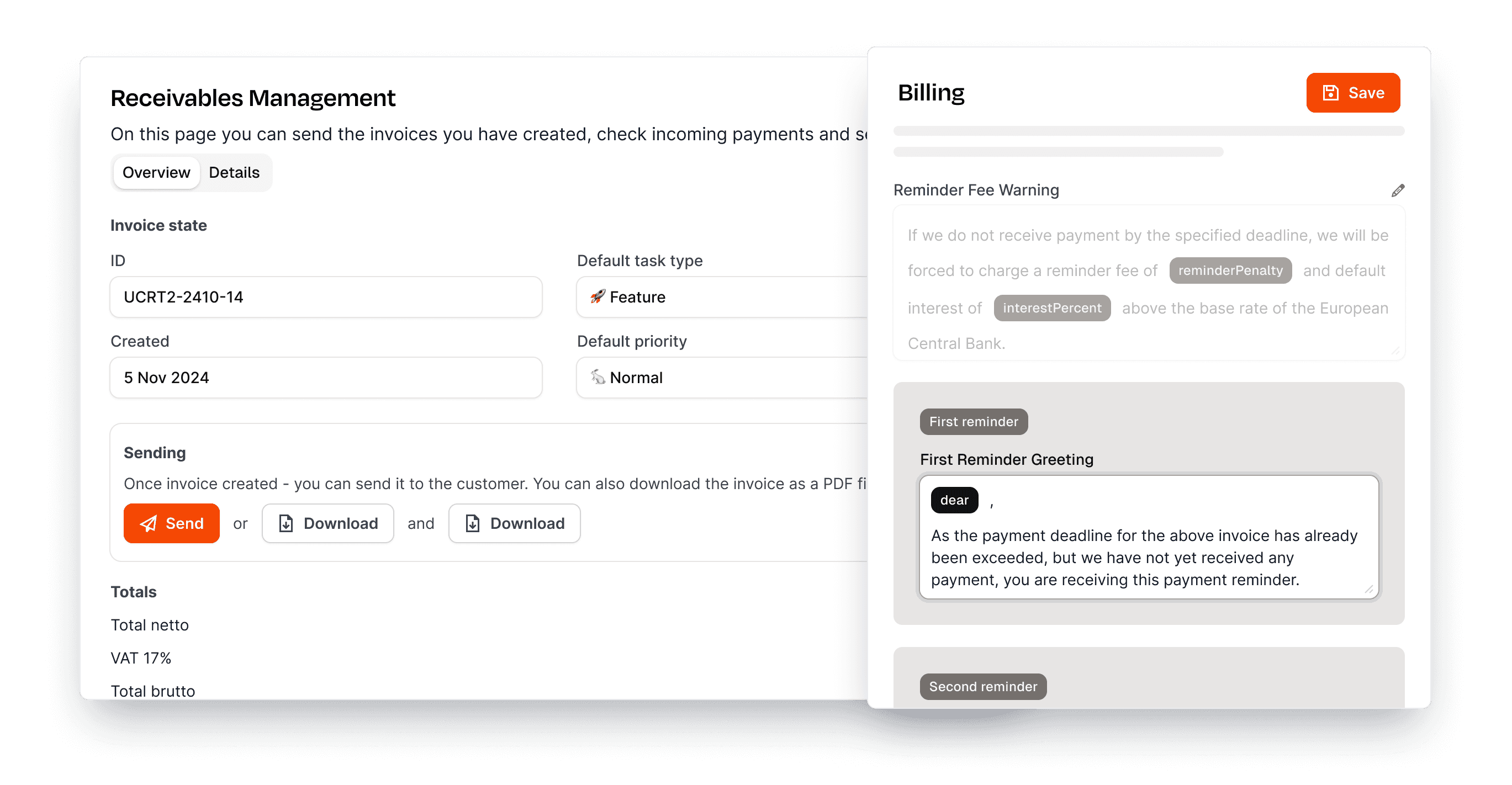
If you're wondering whether your own Invoice Gap is even a problem: calculate how many days pass on average between project completion and invoice send. The number is almost always higher than you'd expect. And every day costs money.
We built Leadtime partly because we were stuck in this exact trap at eins+null — full order books and still liquidity crunches, because invoicing was always the last thing anyone took care of. No epiphany, just frustration that eventually turned into a product.